The Complete Guide to Freelancer Invoicing in Saudi Arabia (2026)
As a freelancer in Saudi Arabia, understanding how to create proper invoices isn't just good business practice—it's a legal requirement. With the implementation of VAT and the rise of the gig economy in the Kingdom, getting your invoicing right has never been more important.
Whether you're a graphic designer in Riyadh, a web developer in Jeddah, or a consultant in Dammam, this comprehensive guide will walk you through everything you need to know about freelancer invoicing in Saudi Arabia in 2024.
Understanding the Saudi Freelancing Landscape
Saudi Arabia's Vision 2030 has dramatically transformed the freelance economy in the Kingdom. The government has actively encouraged self-employment and entrepreneurship, leading to a surge in freelancers across various industries. According to recent statistics, the number of registered freelancers in Saudi Arabia has grown by over 300% since 2020.
This growth comes with increased responsibility. The Zakat, Tax and Customs Authority (ZATCA) has implemented strict requirements for invoicing, and failure to comply can result in significant penalties. Understanding these requirements is crucial for any freelancer operating in the Kingdom.
VAT Requirements for Saudi Freelancers
Value Added Tax (VAT) was introduced in Saudi Arabia on January 1, 2018, initially at 5%. In July 2020, it was increased to 15%. As a freelancer, your VAT obligations depend on your annual revenue:
Mandatory VAT Registration
If your annual taxable supplies exceed SAR 375,000, you must register for VAT. This is non-negotiable and failure to register can result in penalties of up to SAR 10,000.
Voluntary VAT Registration
If your annual taxable supplies are between SAR 187,500 and SAR 375,000, you may voluntarily register for VAT. Many freelancers choose to do this as it adds credibility and allows them to reclaim input VAT on business expenses.
Below the Threshold
If your annual revenue is below SAR 187,500, you're not required to register for VAT. However, you should still issue proper invoices and keep accurate records in case you cross the threshold.
Essential Elements of a Saudi Invoice
A VAT-compliant invoice in Saudi Arabia must contain specific elements. Missing any of these can make your invoice non-compliant with ZATCA regulations:
1. Invoice Header Information
- Your business name (as registered with ZATCA)
- Your address (complete postal address)
- Your VAT registration number (15 digits, starting with 3)
- Invoice number (unique, sequential)
- Invoice date (date of issue)
- Supply date (if different from invoice date)
2. Client Information
- Client's legal name
- Client's address
- Client's VAT number (if VAT registered)
3. Service Details
- Description of services (clear and detailed)
- Quantity or hours
- Unit price (excluding VAT)
- Total amount per line item
4. VAT and Totals
- Subtotal (before VAT)
- VAT rate (15%)
- VAT amount
- Grand total (including VAT)
- Currency (SAR or clearly stated if different)
Creating Bilingual Invoices
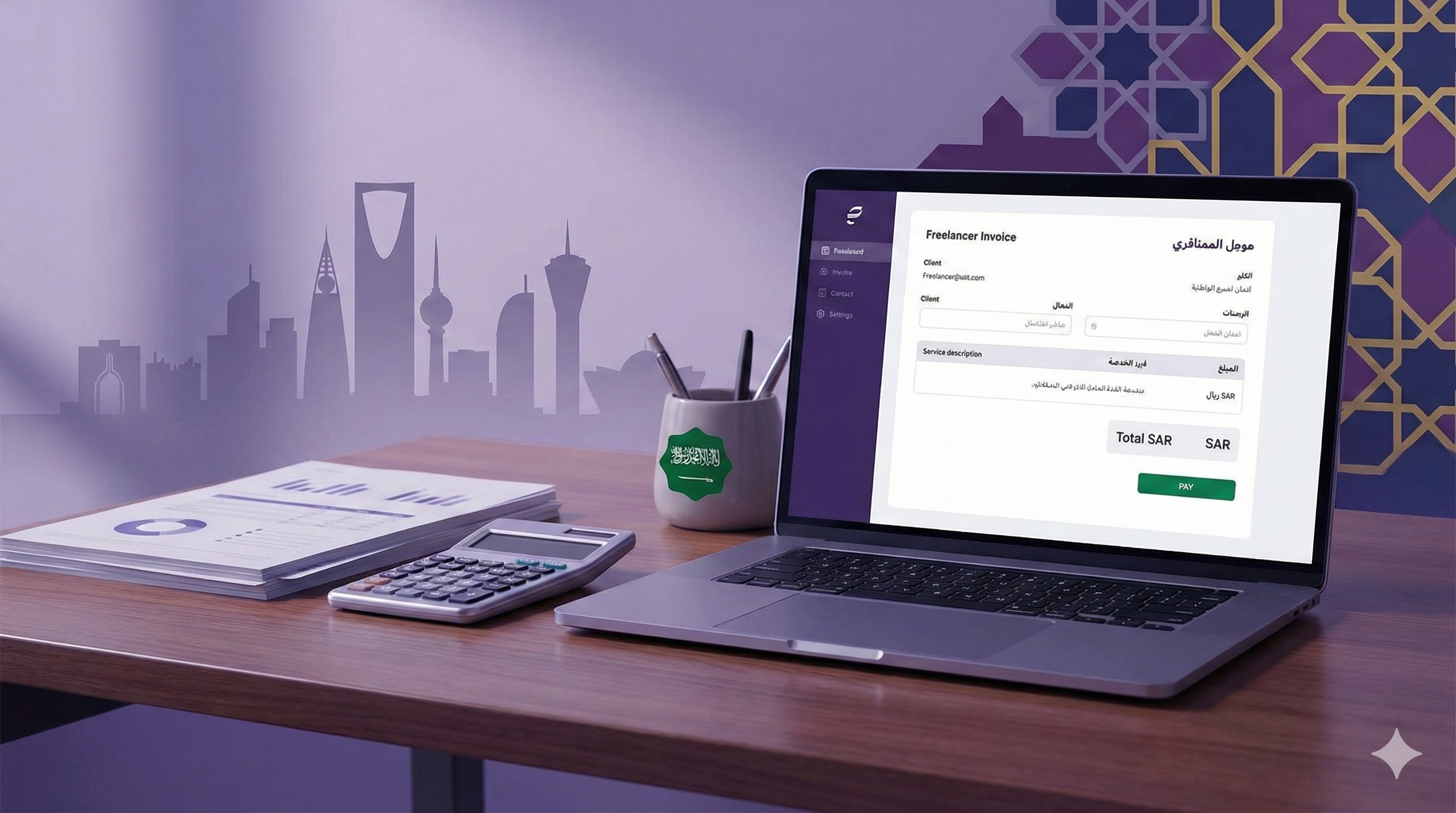
One unique aspect of invoicing in Saudi Arabia is the preference for bilingual invoices. While Arabic is the official language, many businesses operate in English, especially when dealing with international clients.
A professional bilingual invoice should:
- Present information in both Arabic and English
- Use Arabic-Indic numerals (٠١٢٣٤٥٦٧٨٩) alongside Western numerals where appropriate
- Properly handle right-to-left (RTL) text direction for Arabic
- Include dates in both Hijri and Gregorian calendars if required by the client
Payment Terms Best Practices
Setting clear payment terms is crucial for maintaining healthy cash flow. Here are the most common payment terms used by Saudi freelancers:
Net 30
Payment is due within 30 days of the invoice date. This is the most common term for ongoing client relationships.
Net 15
For smaller projects or new clients, you might request payment within 15 days.
Due on Receipt
For one-time projects or clients you haven't worked with before, requesting immediate payment is reasonable.
Milestone Payments
For larger projects, consider breaking the payment into milestones: 30% upfront, 40% at midpoint, 30% on completion.
Retainer Agreements
For ongoing work, a monthly retainer paid in advance provides predictable income and protects both parties.
ZATCA E-Invoicing Requirements
Saudi Arabia has implemented a phased approach to electronic invoicing (FATOORA):
Phase 1: Generation Phase (December 4, 2021)
All taxpayers must generate and store invoices electronically. Handwritten or photocopied invoices are no longer accepted.
Phase 2: Integration Phase (January 1, 2023 onwards)
Taxpayers must integrate their invoicing systems with ZATCA's platform. This is being rolled out in waves based on company size and revenue.
For freelancers, this means using invoicing software that:
- Generates compliant electronic invoices
- Includes QR codes with required data
- Stores invoices in the required format
- Can integrate with ZATCA systems when required
Common Invoicing Mistakes to Avoid
Even experienced freelancers make invoicing mistakes. Here are the most common ones and how to avoid them:
1. Missing VAT Registration Number
If you're VAT registered, your TRN must appear on every invoice. Double-check this before sending.
2. Incorrect VAT Calculation
Always calculate VAT on the net amount, not the gross. Use invoicing software that handles this automatically.
3. Vague Service Descriptions
Don't just write "consulting services." Be specific: "Website redesign consultation - 10 hours including wireframe review and UX recommendations."
4. Missing Payment Terms
Always clearly state when payment is due and what methods you accept.
5. No Invoice Numbering System
Use a consistent, sequential numbering system. ZATCA requires this for audit purposes.
Managing Multiple Currencies
If you work with international clients, you'll likely deal with multiple currencies. Here's how to handle this:
For SAR Invoices
When billing Saudi clients, always invoice in SAR. This is straightforward and avoids currency conversion issues.
For Foreign Currency Invoices
When invoicing international clients in USD, EUR, or GBP:
- Clearly state the currency on the invoice
- Include the exchange rate used (if converting to SAR for your records)
- Note that VAT may or may not apply depending on where the service is consumed
VAT on Exported Services
Services provided to clients outside Saudi Arabia may be zero-rated for VAT purposes. However, you must maintain documentation proving the service was consumed outside the Kingdom.
Record Keeping Requirements
ZATCA requires you to maintain invoicing records for a minimum of 6 years. This includes:
- All issued invoices
- All received invoices (for input VAT claims)
- Supporting documentation
- Contracts and agreements
- Bank statements showing payments received
Use cloud-based invoicing software that automatically stores and backs up your records. This makes compliance much easier and protects you in case of an audit.
Tools and Software for Saudi Freelancers
The right invoicing software can save you hours every month and ensure compliance. Look for software that:
- Supports Arabic and English (bilingual invoices)
- Automatically calculates 15% VAT
- Generates ZATCA-compliant invoice formats
- Includes QR codes as required by e-invoicing regulations
- Stores invoices securely in the cloud
- Sends invoices via email directly to clients
- Tracks payment status
- Supports multiple currencies
Getting Paid: Bank Transfers and Payment Methods
In Saudi Arabia, the most common payment methods for freelancers are:
Bank Transfer (IBAN)
Include your full IBAN on every invoice. Saudi IBANs are 24 characters and start with "SA".
SADAD
Saudi Arabia's national electronic bill presentment and payment system. Large companies often prefer paying through SADAD.
Digital Wallets
Services like STC Pay and Mada Pay are increasingly popular for smaller payments.
International Payments
For international clients, services like Wise (TransferWise) or PayPal can be useful, though they come with fees.
Handling Late Payments
Despite your best efforts, some clients will pay late. Here's a professional approach:
Prevention
- Screen clients before starting work
- Request deposits for new clients
- Use clear contracts with payment terms
- Send invoices immediately upon completion
Follow-Up
- Send a friendly reminder 3 days before due date
- Follow up on the due date if not paid
- Send a firmer reminder 7 days after due date
- Consider late payment fees (if stated in your contract)
Escalation
For persistently late payers, you may need to pause work, engage a collection service, or as a last resort, pursue legal action through the Saudi courts.
Tax Deductions for Freelancers
While this article focuses on invoicing, it's worth noting that as a freelancer, you can claim input VAT on legitimate business expenses. Keep invoices for:
- Software subscriptions
- Office equipment
- Professional development
- Marketing expenses
- Professional services (accounting, legal)
Conclusion: Professional Invoicing Builds Professional Businesses
Proper invoicing is more than just getting paid—it's about building a professional reputation. Clients notice when your invoices are clear, compliant, and easy to process. It reflects the quality of your work and your professionalism.
By following the guidelines in this article, you'll:
- Stay compliant with ZATCA regulations
- Get paid faster with clear, professional invoices
- Build trust with clients through transparency
- Maintain accurate records for tax purposes
- Position yourself as a serious professional in the Saudi market
Ready to streamline your invoicing? Try Freelancer Fatura free and create your first VAT-compliant invoice in minutes. Our platform is designed specifically for MENA freelancers with built-in support for Arabic, 15% VAT calculation, and ZATCA-compliant formats.